Mon to Sat: 9:00am to 6:00pm
-
-
-
Office No. 302, 3rd Floor, The Business Center, Erandwane, Pune
Mon to Sat: 9:00am to 6:00pm
Office No. 302, 3rd Floor, The Business Center, Erandwane, Pune




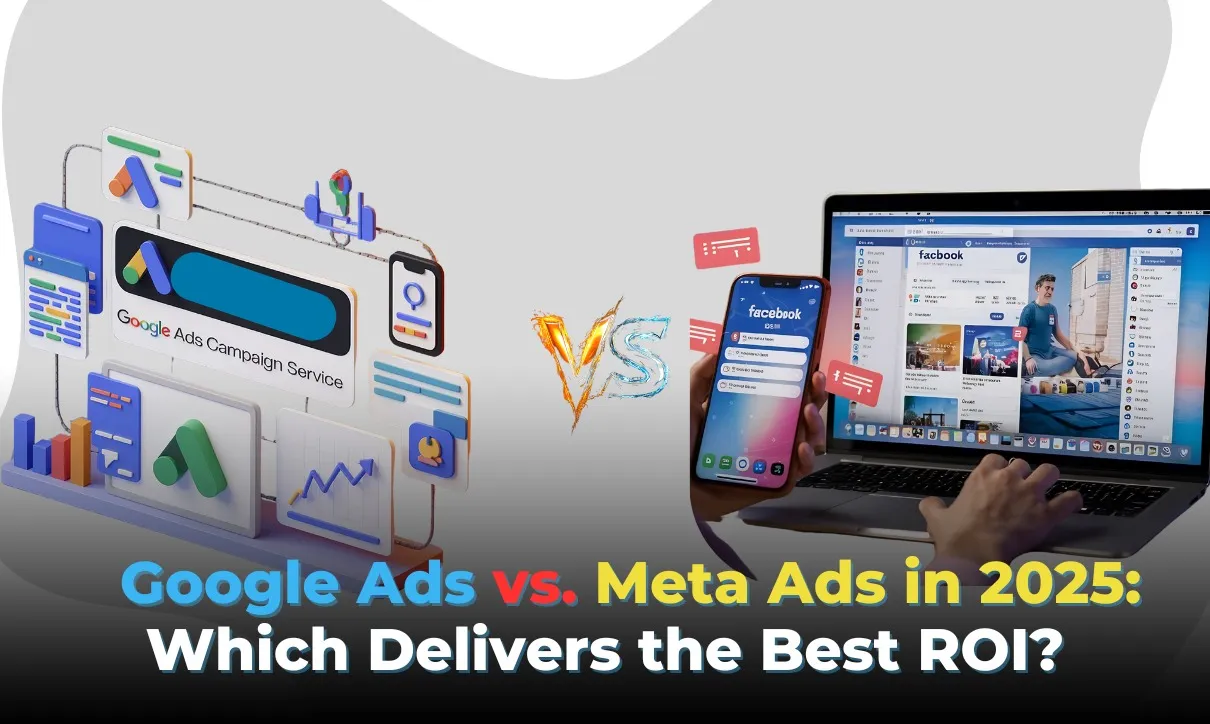
In the rapidly changing world of digital marketing, choosing the right advertising platform is more important than ever. As we step into 2025, two legendary landscapes dominate: Google Advertisement and Meta Advertisement (East Facebook Advertisement). Both platforms offer powerful equipment, broader access, and targeted capabilities - but which gives you the best return on investment (ROI)?
Whether you are the owner of a small business, a digital marketer, or a brand strategist, understanding the strengths and limits of each platform can help you spend better on advertising. In this article, we take a detailed comparison of Google advertisements and Meta ads, display matrix discovery, targeting options, cost-effectiveness, and real-world results-so you can confidently choose which maximizes your marketing effect in 2025.
With the ability to post advertisement on youtube, Google search and Google display network, Google Advertisement is the largest search advertising network globally.
Advertisements of Facebook, Instagram, Messenger and Audience Network are now included in meta advertisements, earlier known as Facebook advertisements.
In conclusion, Google Ads focuses on people who are actively looking for answers.Even when a user isn't actively searching, Meta Ads nevertheless target them according to their identity.
| Feature | Google Ads | Meta Ads |
|---|---|---|
| Targeting | Keyword & intent | Audience interest & behavior |
| Ad Placement | Search, Display, YouTube | Facebook Feed, Stories, Reels, Messenger |
| User Intent | High (Search-based) | Passive (Interrupt marketing) |
| Learning Curve | Steeper | Easier for beginners |
| Cost | Varies by industry | Generally lower CPC |
In summary, Google Ads targets individuals who are actively seeking solutions.
By 2025, both platforms' targeting features have advanced to include AI-driven accuracy.
Google Ads
Using Google AI to improve predicted audiences
Custom intent targeting and in-market targeting
Comprehensive demographic data
Machine learning-driven intelligent bidding tactics
Meta Ads
AI-Powered Advanced Lookalike Audiences
Retargeting based on engagement
Improved contextual cues and interest layering
AI-generated recommendations for the audience
Conclusion
Even a missing “Rd.” vs. “Road” can confuse Google and reduce your trust score.
Search Ads by Google Ads
Ads on Display
Advertisements for Shopping
YouTube Video Promotions
Campaigns for Performance Max
Meta Ads
Carousel Advertising
Ads for Reels
Ads for Stories
Lead Promotion
Click-to-Message Advertisements on Messenger and Instagram
2025 Trend: Short-form videos and interactive ads are hugely popular. Google is best in Performance Max advertisements and YouTube Shorts, whereas Meta is best at Reels and Stories.
The average CPC for Google Ads (2025) is $0.60 for display and $2.10 for search.
Increased intention to buy
Good local and B2B service ROI
Average CPC for Meta Ads (2025): $0.80
Reduced conversion rates in expensive sectors
Better for consumer goods that are purchased on impulse
In conclusion, Google Ads frequently convert better because of high-intent traffic, even when Meta Ads are less expensive. However, the product and funnel determine ROI.
In fact, to understand how well your advertising campaign is performing - especially on platforms such as Google advertisements and meta advertisements - this significant performance is important to keep an eye on the metrics. One of the most important of them is Click-Through Rate (CTR). CTR tells you how percent people who see your advertisement actually click on it.
It is an effective way to understand how attractive and relevant your advertisement is to your audience, looking at the click-wealth rate (CTR). Simply divide the total number of clicks on your ad by the number of impressions at that moment, and then multiply the result by 100 to find out. Your CTR will be 5%, for instance, if your ad is seen 1,000 times and 50 clicks are made.
100.
Why Does It Matter?
A high CTR suggests that your target audience will find your ad interesting and relevant.
Higher CTRs are rewarded with better ad positions and lower prices on websites like Google and Meta because of higher quality or relevance rankings.
Benchmark Examples for 2025
4% to 6% for Google Search Ads
1% to 2% for Google Display Ads
1.5% to 2.5% for Facebook and Instagram meta ads
Cost per click
Is defined as the price you pay each time a user clicks on your advertisement.
CPC is calculated as total ad spend divided by total clicks.
Why Is It Important?
It has an immediate effect on your ROI and ad expenditure.
You can receive more traffic for less money if your cost per click is lower.
Cheap traffic doesn't always translate into valuable traffic, so if those clicks don't convert, a low CPC isn't always the best option.
Elements That Affect CPC:
Competition in the industry
Targeting an audience
Placement of ads
Benchmark Examples for 2025
CPC for Google Ads: around $1.00 for display, $1.80 to $2.50 for search
Meta Ads' CPC ranges from $0.70 to $1.20, depending on the industry and placement.
Conversion Rate (CVR):
The percentage of customers who click on your ad and finish a desired activity (such filling out a form or buying something).
(Total Conversions / Total Clicks) multiplied by 100 is the conversion rate.
It shows how well your landing page and offer turn visitors into leads or customers.
A high conversion rate shows that your funnel is optimized and your visitors is well-targeted.
What Makes It Important?
It also significantly affects your Cost Per Acquisition (CPA) and Return on Ad Spend (ROAS).
Benchmark Examples for 2025
Google Ads: 4% – 6% (Search), 2% – 4% (Display)
Meta Ads: 2% – 4% (average for lead or conversion campaigns)
Knowing how each platform functions in various industries is essential when deciding between Google Ads and Meta Ads. Despite being strong digital advertising tools, their efficacy varies according to your product category, target market, and sales funnel stage.
This is a summary of each platform's performance by industry in 2025, based on advertising trends, ROI potential, and existing trends.
The Best Platform for E-Commerce:
1. Meta Ads
Why: Meta advertisements' powerful visual forms (carousel, reel, and story advertisements), sophisticated retargeting, and AI-driven product recommendations make them ideal for e-commerce. Product discovery frequently influences users as they browse Facebook or Instagram.
Use Case: Accessories, devices, fashion, and beauty.
1. Meta Ads
Why: Meta advertisements' powerful visual forms (carousel, reel, and story advertisements), sophisticated retargeting, and AI-driven product recommendations make them ideal for e-commerce. Product discovery frequently influences users as they browse Facebook or Instagram.
Use Case: Accessories, devices, fashion, and beauty.
2. Local Services (such as repairs, salons, and plumbing)
Google Ads is the best platform.
Why: People use terms like "best dentist in [city]" or "AC repair near me]" when looking for urgent or location-specific services. Google Search is perfect for service-based firms because it captures this high intent.
Use Case: Clinics, hairdressers, auto repair shops, and electricians.
3. Google Ads is the best platform for B2B and SaaS.
Why: In order to get answers, B2B buyers frequently start their research by using search engines. High-quality traffic with a strong commercial purpose is captured by Google Ads, particularly Search and Performance Max.
Use cases include IT solutions, project management systems, HR tools, and CRM software.
4. Google Ads (Search & YouTube) plus Meta Ads (for Retargeting) is the Best Platform for Real Estate
Why: Google is best suited for real estate consumers who look for specific demands (such as "flats in Pune under 50 lakhs"). Meta is helpful for brand visibility and remarketing, though.
Use Case: Housing platforms, brokers, agents, and builders.
5. The Best Platform for Education and Online Courses: Both (Hybrid Strategy)
Why: Google collects high-intent searches for certain courses or institutions, while Meta is excellent for raising awareness and generating leads through visual storytelling.
Use Case:Programs for skill development, ed-tech platforms, and online coaching.
6. Meta Ads is the Best Platform for Hospitality, Travel, and Tourism
Why: Choosing to travel is an emotional choice. Meta creates desire and motivates action with its visual storytelling in the form of photo carousels and films.
Use Case: Include homestays, hotels, resorts, and vacation packages.
7. Meta Ads is the Best Platform for Events & Entertainment
Why: By utilizing its social sharing capabilities, Meta provides events with greater reach and participation. Perfect for increasing ticket sales, RSVPs, and buzz.
Use Case: Webinars, concerts, workshops, and festivals.
Last Thought
Allocating your ad spend effectively requires knowing how each advertising platform performs in your particular business. While Meta Ads flourish in visually driven businesses that profit from brand storytelling and discovery-based experiences, Google Ads frequently perform best in industries with clear intent and defined demands.
Start with a small test budget on both platforms and evaluate your return on investment before increasing if you're not sure which to focus on
Pose the following queries:
Are your clients looking for you right now? ← Ads on Google
Does your product have a pleasing appearance? ← Meta-Ads
Do you have a limited budget? ← Meta-Ads
Do you require leads of superior quality? ← Ads on Google
Pro Tip: Make use of both simultaneously. Use Meta for top-of-funnel campaigns and Google for retargeting and search.
Employ AI-Powered Campaigns: Two of the top ROI generators are Advantage+ Shopping (Meta) and Performance Max (Google).
Retarget your Meta readers on Google Search by combining remarketing lists.
Employ Video Content: On both platforms, short-form videos boost CTR.
Make sure landing pages are mobile-friendly and load quickly.
Monitor Conversions Properly: Set up Google Analytics 4 and Meta Pixel accurately.
The competition between Google Ads and Meta Ads is more fierce than ever in 2025. Every platform has unique benefits. Google Ads is the best for high intent. Meta Ads win in terms of brand reach and imaginative narrative. Knowing when and how to employ both together in your marketing funnel will yield the best return on investment, not picking just one.
FAQs


Meta advertising are perfect for eCommerce since they provide better visual product placements and catalog ads.
24
Sep 22Lorem Ipsum is simply dummy text of the printing and typesetting industry.
24
Sep 22Lorem Ipsum is simply dummy text of the printing and typesetting industry.